Showing posts with label Articles. Show all posts

Thursday, 1 May 2014

Snapshots. 10th Anniversary of "Mean Girls"


The New Yorker
Why "Mean Girls" Is a Classic
Richard Brody - 30/04/2014

When I mentioned to my daughters that it’s the tenth anniversary of the release of “Mean Girls,” it was no news to them: the firstborn, now twenty-one, is wearing her “You can’t sit with us” T-shirt, and her sister, sixteen, is dressed in pink (it’s Wednesday). They knew the movie by heart long before they knew from high school. To the catchphrases that were common coin at home, from “Singin’ in the Rain,” “Marnie,” “The Gang’s All Here,” “The Little Mermaid,” “Mary Poppins,” and “Legally Blonde,” there was added a torrent of word vomit:

“Four for Glenn Coco! You go, Glenn Coco! None for Gretchen Wieners.”

“You can’t just ask people why they’re white.”

“You will get chlamydia and die.”

“It’s like I have ESPN or something.”

“Brutus is just as cute as Caesar, right?”

“I’m the cool mom.”

And, of course, the inevitable “I can’t help it if I’ve got a heavy flow and a wide-set vagina.” And “Well, this has been sufficiently awkward.”


XOXO


P.D. Read the full article at The New Yorker website 

Friday, 25 April 2014

New Discovery. Cereal Magazine ....


Nothing makes my inner book-worm happier than finding a new magazine to lay our eyes (and hands) on. 
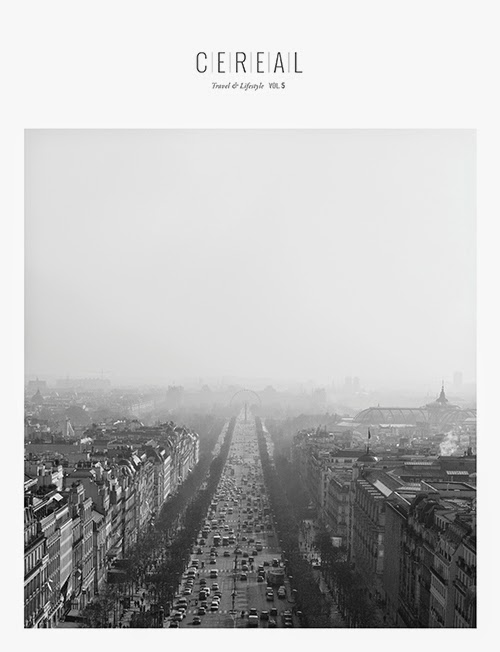
I found Cereal Magazine by chance, gazing absent-mindedly through the never ending shelves of publications at Magma; as soon as I eyed its greyscale cover, with Paris photographed in black and white and the simplicity of its font, I knew it was love at first sight. 

The inside didn't disappoint. With the majority of lifestyle/fashion magazines nowadays we are used to being bombarded by colour, graphics, striking and attention- grabbing text; everything over the top, magnified. Cereal has a soothing effect in my eyes. I can feel my mind quieting down from all the noise we are fed everyday through the media and entering a zen state of mind, flipping through its thick, textured pages with incredibly beautiful photographs of the Cornish seaside to black and white Paris. The text also provides an escape from my mundane day-to-day, transporting me to Helsinki's architectural scene or a secret rainforest in the Scilly islands. 

I do not know how I will survive until the next issue comes out. My hunger for what I call "beautiful journalism" will have to be quenched by their blog, overflowing with equally-stunning images. 
Enjoy


XOXO

P.D. You can read here the editor's letter from Issue 5. It is a love-letter to travelling (and travellers)

Monday, 31 March 2014

Books #3. Jeune Fille en Dior ....


In Jeune Fille en Dior, released in French bookstores in October, the illustrator Annie Goetzinger invites us to follow her heroine behind the scenes at 30 Avenue Montaigne, during the era of Monsieur Dior. 
A visual novel in which fiction mixes with the house's history with poetic freshness.


On February 1947, just before Christian Dior's debut fashion show, the level of excitement and anticipation was at fever pitch. It's here that the story of the house of Dior starts, and with it the story of Clara, a young reporter from a modest background for the magazine Jardin des Modes, the creation of the illustrator Annie Goetzinger. Through her awestruck eyes we rediscover the tony atmosphere of the house's historic heart and the rich clients coming to see the collection, the behind-the-scenes buzz, the attentiveness of Monsieur Dior to his "cheries" - the women who inspired him  - and his "jeunes filles" - the house models. And not forgetting the enthusiastic reaction of the journalists who, like Carmel Snow of Harper's Bazaar, sang the praises of the "New Look". As the fates of the couturier and Clara converge, with her also becoming a "jeune fille", the book retraces Dior's global success, the rituals preceding the showing of each collection, transporting us from Paris to Dallas, passing by Granville, until Christian Dior's death in 1957. 


For Annie Goetzinger, the author and illustrator of Jeune Fille en Dior, after having worked with the biggest names in comic book publishing, the idea of an illustrated novel about the house at 30 Avenue Montaigne arose quite naturally. "I wanted to recount how Dior built his house. There was a real before and after that famous fashion show of 1947." explained this woman who had grown up in a family of dressmakers before starting her career as a fashion illustrator. With equal priority given to the details of her drawings as to the facts they relate, Annie Goetzinger brings to life the creative yeats that shaped the house's foundation: a colourful story, as captivating to read as it is beautiful to look at.

Buy the book at Dargaud

Source: Dior Magazine

XOXO

Saturday, 15 March 2014

Looking Back. La Llamada / The Call ....


I remember reading this piece of writing at High School. It was during a mock exam for Spanish Language. Everybody was expecting an endless, boring article about the misuse of Vs and Bs but instead we found this surprisingly touching short story and a minute after, all the girls sighted and looked up with dreamy eyes, as if they had just felt the emotions written on the paper. 
 Is one of those fleeting moments that somehow stay in your memory long after you leave those halls. It was written and published in 2001 which means we already read it years afterwards and now, 11 years later, it feels as current as if it was written yesterday.
After last night's charade down memory lane with Britney, Black Street Boys and 50 cent, I though it was worth remembering, for old times' sake.


Llamada

MANUEL VICENT 8 DIC 2002

No había nadie en el bar salvo ellos dos, una pareja de adolescentes sentados frente a frente, bebiendo inocentes refrescos de naranja. En la mesa entre los vasos habían dejado abiertos los teléfonos móviles, que sonaban a veces y entonces él o ella se ponía a charlar alegremente con un ser ajeno e invisible mientras el otro se quedaba hierático. El chico estaba muy enamorado de la chica, pero era incapaz de manifestarle su pasión. Sólo se atrevía a mirarla con intensidad a los ojos y ella ya había captado las turbulencias del corazón de su amigo y también le amaba, pero no podía ayudarle en nada, debido a su extremada timidez. Hablaban de cosas anodinas, sin comprometerse en absoluto. Las palabras iban del uno al otro directamente a través de la vibración del aire sobre el mármol de la mesa. El chico necesitaba declararle su amor y la chica esperaba que lo hiciera ya de una vez, un sueño imposible, porque entre ellos había una barrera psicológica insalvable. Cualquier gesto o inflexión de voz, al estar sus rostros tan cerca, podía delatar un sentimiento íntimo y eso les llenaba de terror. Había media luz en el bar, el hilo musical vertía una melodía propicia y los labios de los enamorados permanecían a una mínima distancia infranqueable. El corazón de los adolescentes tiene hoy un compartimento más. Se compone de dos ventrículos, de dos aurículas y de un teléfono móvil, que también bombea sangre. De pronto, este joven tímido y enamorado tuvo una inspiración. Usó el móvil para hablar con la chica que tenía delante sin dejar de mirarla profundamente a los ojos. Cuando sonó la llamada la chica descolgó. La pareja comenzó a hablarse de forma descarnada como si fueran invisibles. Ninguno de los dos ignoraba que a través de los móviles su voz se convertía en ondas electromagnéticas, viajaba al espacio sideral y luego volvía para penetrar en el cerebro del otro. Brutalmente desinhibido el chico le dijo la amaba. La chica le contestó que todas las noches soñaba con él, pero sus expresiones de amor sin amarras tenían dos vehículos: una voz recorría el aire sobre la mesa del bar por medio de la vibración natural y sonaba terriblemente vulgar; la otra bajaba desde un satélite de la estratosfera cargada de libertad e imaginación. "Te amo, te amo"-le decía el chico. "Oigo dos voces a la vez, ¿a cuál de ellas debo creer?"- preguntó ella. El chico le dijo que creyera en el amor que a través de las ondas magnéticas le llegaba por la sangre hasta el corazón. 


There was nobody in the bar except two of them, a teenage couple sitting face to face, drinking innocent orange sodas. On the table between the glasses, they had left open their mobile phones, which buzzed at times and then he or she started chatting happily with someone else remote and invisible while the other remained inscrutable . The boy was very much in love with the girl, but was unable to express his passion. He only dared to look intently into her eyes and she had already captured the turmoil in his friend's heart and loved him back, but could not help him at all because of her extreme shyness . They talked about ordinary things, without compromising at all. The words went from one to another directly through the vibration of air on the marble table. The boy needed to declare his love and the girl expected it once and for all, an impossible dream because between them there was an insurmountable psychological barrier. Any gesture or inflection, being their faces so close, could reveal an intimate feeling, and that filled them with terror. The bar was half lit, the music propitious and the lover’s lips remained at a minimum impassable distance. The hearts of teens today have one more compartment. It consists of two ventricles and two atria of a mobile phone, which also pumps blood. Suddenly this young, shy and enamoured boy had an inspiration. He used the phone to talk to the girl in front of him without taking his eyes off her. When it rang the girl picked up the call. The couple began to speak with complete lack of inhibition, as if they were invisible. Both were aware that through the mobiles, their voices became electromagnetic waves traveling into space and then back to penetrate the brain of the other. Brutally uninhibited the boy said he loved her. The girl replied that every night she dreamed of him, but his expression of loosened love had two vehicles:  one voice travelled through the air over the table in the bar by  natural vibration and sounded terribly vulgar , the other came down from a stratospheric satellite charged with freedom and imagination . “I love you, I love you," the boy said. "I hear two voices at once, which of them should I believe?” - She asked. The boy told her to believe in the love which through the magnetic waves reached her through the blood and then to her heart .


XOXO

Saturday, 28 December 2013

Books #3


It was about time I gave a little attention to this absolute classic. Published over two decades ago, The Virgin Suicides by Jeffrey Eugenides, is indisputably one of the most influential reads of contemporary literature, both in content and style. Writing a book about the mass suicides of 5 sisters in a small town in Michigan is no easy task, but it is even harder to do so using as a narrator a group of infatuated, close- to - obsessive  teenage boys, now grown up, reminiscing about the cloistered lives of the Lisbon girls. The style, however, is what struck me most about the novel. The attention to detail, as if each adjective has been carefully chosen, softly placed into the sentence to kindle your imagination and transport you to a candle-lit room or the boys' tree house. What it never does is let you in any of the girl's heads. Their surroundings: school corridors, interior of their rooms, house, front yard, clothing ect are described down to the last scratch. But we are never allowed into the brains or the emotions which led down to their ends. The mystique which the Lisbon sisters have over the boys is the same one that possesses the reader and it is both absorbing and infuriating at times; you want to scream at the girls' window, tell them to get out, run and never look back. 

Hauntingly beautiful and heartbreaking, it is a must read. 


The New York Times
By MICHIKO KAKUTANI
March 19, 1993

"It didn't matter," Mr. Eugenides's narrator recalls, "whether her brain continued to flash on the way down, or if she regretted what she'd done, or if she had time to focus on the fence spikes shooting toward her. Her mind no longer existed in any way that mattered. The wind sound huffed, once, and then the moist thud jolted us, the sound of a watermelon breaking open, and for that moment everyone remained still and composed, as though listening to an orchestra, heads tilted to allow the ears to work and no belief coming in yet. Then Mrs. Lisbon, as though alone, said, 'Oh, my God.' " On her second try, her daughter Cecilia had succeeded in "hurling herself out of the world."

This terrible event, along with the subsequent suicides of Cecilia Lisbon's four pretty sisters, feels like something out of a Greek tragedy. It's not at all the sort of thing one expects to find in a coming-of-age story set in the leafy Detroit suburbs of the 70's; and as related by Mr. Eugenides, the deaths of the five Lisbon sisters take on the high, cold shimmer of myth. Their suicides become a symbol of the innocence lost as adolescents are initiated into the sad complexities of grown-up life, and the lost, dying dreams of a community that finds its collective dreams of safety spinning out of reach.

Beautiful and eccentric, the sisters have captured the imagination of the neighborhood boys, who spend hours spying on them and collecting souvenirs of their lives: snapshots taken by neighbors, cosmetics stolen from the garbage, a brassiere filched one night from the house. What is the girls' magical allure? In an ordinary suburban world of lawnmowers and barbecues, they represent the extraordinary: the odd, the inexplicable, the romantically extreme.

Under the thumb of their domineering mother -- who never allows them to date, and who insists they wear baggy, ridiculous clothes -- the Lisbon girls lead strangely hermetic lives, defined by church and school. Though their ineffectual father seems vaguely sympathetic to their plight, he never stands up to their tyrannical mother.

Eventually the boys succeed in taking the Lisbon sisters on a single group date, but Lux breaks her mother's curfew and the girls are permanently grounded. They are pulled out of school and locked in the house. In one memorable scene, their suitors make a last-ditch effort at communication. Having managed to get the girls on the phone, they begin playing them their favorite songs: "You've Got a Friend," "Wild Horses" and "Time in a Bottle." The girls respond by furtively playing some of their favorite songs: "Alone Again, Naturally," "Where Do the Children Play?" and "So Far Away."

Nothing, however, impedes the girls' withdrawal from the world. "The house receded behind its mists of youth being choked off," Mr. Eugenides's narrator recalls, "and even our own parents began to mention how dim and unhealthy the place looked." Leaves pile up on the lawn, garbage collects by the curb, and at night, raccoons prowl its yard. Sour, unpleasant smells seep out of the house, and grime and dust soon cover over its windows and doors.

The reader repeatedly wonders why the girls don't rebel. Why don't they reach out to friends, or run away from home? Why don't the authorities insist that they go to school? What has driven their mother to impose such a strict regime in the first place?

 Gradually, however, the narrator's hypnotic voice succeeds in transporting us to that mythic realm where fate, not common sense or psychology, holds sway. By turns lyrical and portentous, ferocious and elegiac, "The Virgin Suicides" insinuates itself into our minds as a small but powerful opera in the unexpected form of a novel.


XOXO


Monday, 25 November 2013

Articles. Sylvia Plath, The Multitudinous Woman ...


Today, I bought the Spanish magazine Vanidad. I usually don't purchase the hard print copy but look through their website. They have great contents and interviews about fashion, music, cinema and arts in general. In a section named Ojalá Siguiera Viva, meaning "Wishing she was still alive",  this month's chosen figure was Sylvia Plath. Of course, this brought all kinds of memories about her book "The Bell Jar" and the adaptation I was part of at University earlier this year. You can see a bit more here and here. Apart from being a good piece of biographical writing, it also brings to attention her feminist labour and how she became an icon representing women who wanted more from life apart from cleaning, cooking and having children. I have tried to translate it as correctly and faithfully as possible.
Para los lectores españoles, podéis leer el artículo completo aquí.


After sealing the door and kitchen windows with wet towels, she put her head in the oven. Carbon monoxide did the rest. She was 30 years old and had two children. She was called Sylvia Plath. This year is the half-century anniversary of the poet, one of the great icons of American popular culture. Her only novel, “The Bell Jar”, published a month before her suicide, appears in the hands of characters like Lisa Simpson, the witch Sabrina and Rory from “Gilmore Girls”.  “Sylvia Plath, an interesting poetess whose tragic suicide was interpreted as romantic by the college girl’s mindset” says Alvy Singer (Woody Allen) while holding in his hands a copy of “Ariel” in his first visit to Annie Hall’s (Diane Keaton) apartment. In 2001, Ryan Adams published a song called “Sylvia Plath” from the album “Gold”. In 2003 Gwyneth Paltrow gives life to the poet in the film “Sylvia”. In 2009, Lady Gaga quotes her in her song “Dance in the Dark”. This month it is published in USA a volume devoted exclusively to the drawings done by Sylvia. Cursed poet, good girl, pioneer of feminism, model for teen magazines, romantic suicidal housewife…

Sylvia Plath held many of the elements that fascinate restless minds, and many minds, unfortunately, are only restless during adolescence. When she finally suicide, in her London home in 1963, she was a housewife who wrote at dawn, before her children woke up. She prepared food, took them to the park… She had been abandoned by her husband, poet Ted Hughes, who left her for another poet Assia Wevill (who also committed suicide sticking her head in an oven). Put Plath, chronically depressed, had already tried twice before.
Born in Boston in 1932, Sylvia lived a happy childhood that disappeared at age eight, when her father Otto died.” I will never talk to God again” she said then. At age 11 she began a journal that she’d never abandon. It recounts her life at Smith College, a school for girls where men could not go to the first floor and where girls especially dressed for dinner. Sylvia received an award from the women’s magazine “Mademoiselle” which enabled her to spend a month in New York. There she experienced a tension that never was resolved: to be an American good girl, who posed Betty Garble style on a swimsuit and was obliged to please men, or become an intellectual who broke with the destiny patriarchy had chosen for her. The same dilemma was lived by thousands of women, young and old, who saw themselves reflected in Plath’s work and also in her life. 

On the way back from New York, after disappearing for three days and making it to the papers, made maybe into the first it girl in history, she tried to take her life. “This has been my last act of love” she said then. After passing through a Psychiatric facility and receiving electroshock therapy, Sylvia recovered and traveled on a scholarship to Cambridge. There she met the man of her life, Ted Hughes. They started writing poems to each other and Sylvia started exposing her innermost anxieties in her verses, “confessional poetry”. They married in 1956 and came back to the States. They had two children, Frieda and Nicholas. The latter became an eminent zoologist. In 2009, he committed suicide.
Back to Sylvia. In September 1962, on her way back to UK, she discovers her husband’s infidelity. The poet suffers a car accident, a second attempt at suicide. She survives and writes “Ariel”, one of her masterpieces, who many consider “ a long suicide note”. Sylvia found her death a year later and her fame began to grow. Her story made such an impact that it gave life to the “Sylvia Plath effect”, a term coined in 2011 by the psychologist James C. Kaufman to describe the tendency to mental illness in certain types of writers.

Sylvia Plath died a victim of a decision which changed her life: she was forced to choose one way of being a woman. She voiced the alarm about this silent form of male oppression. Fortunately, today more and more women can choose what and how they want to be, and can do so without excluding any of the facets which constitute the intimate reason of being a diamond.


XOXO


Sunday, 30 December 2012

As long as the world exists, there will be a party...


Reading yesterday's magazine S Moda,  supplement that comes with the newspaper El Pais, I found this article that I think it is fascinating. It talks about parties, and the relationship between them and literature and cinema. Every great film has a great party, from Breakfast at Tiffanys to The Great Gatsby and La Dolce Vita. It seems like in times of depression and crisis (like the ones we are living now, at least Spain), is when parties are most needed to lift people's spirits and encourage them to leave their problems outside the door. 

With New Year's approaching, I though it would be a fitting subject. I am not the biggest fan of parties, I must admit. Sometimes, I have to drag myself out the door when I'd rather be curled up in the sofa, in my piyamas, watching a rom-com (or any other kind of movie). But New Years Eve feels like a different night, like it should be special, magical somehow. I've never found that night any of the adjectives mentioned before. It is as dirty, sweaty and, by the end, un-glamorous as any other Saturday night. People always get too drunk, there are fights, vomit, booze everywhere, ripped tights, lost shoes and shoeless girls walking the streets at dawn. It's like a scene from a horror movie.... 

Anyway, of course I am exaggerating and this is only my point of view; I'm sure the rest of the world looove tomorrow's night and can't wait to put on the high heels. As for me, I think to myself every year that it will be different and something amaaazing will happen. At the end, the only amazing thing is that my friends manage to remember what they were wearing the night before. But I love them for that, and if it weren't for them, I wouldn't go out at all. At the end, New Year's Eve is about being with family and friends, not the alcohol or the fashion.

Here is the article, in Spanish, but I've put google translation at the bottom.It won't be great but it is something!.

LISTOS, VESTIDOS… ACCIÓN
Por Boris Izaguirre

El cine y la literatura mantienen una excelente relación con las fiestas. Unas viajan de una disciplina a otra, como sucede en Desayuno con diamantes, la legendaria novela de Truman Capote. Tanto en las páginas como en el celuloide, Holly Golightly consigue maravillarnos con la exuberante fiesta que celebra en su diminuto apartamento neoyorquino. Mezcla rufianes y prostitutas de lujo con artistas emergentes y varones sin rumbo, como el playboy brasileño, interpretado por José Luis de Vilallonga en la película, que consigue salir del minúsculo baño al todavía más minúsculo balcón sin perder de vista su güisqui. En una entrevista, Vilallonga confesó que el famoso gato de Holly, que salta aterrorizado entre los invitados, eran en realidad tres y que la filmación de la secuencia duro casi una semana. El resultado forma parte de nuestros anhelos: sucumbir a una parranda sin fin en poquísimos metros cuadrados.


Hay fiestas divinas, aunque en realidad sean escenas, como la de Marilyn Monroe tocando el ukelele a bordo de un tren en ‘Con faldas y a lo loco’. Humor, erotismo y fiesta, como sucede también en Risky Business, con un Tom Cruise que aprovecha unas vacaciones de sus padres para convertir su casa en un riesgoso burdel. Son películas clave para sus actores y sus generaciones. Y su escenificación de las fiestas podrían tener parte de su «origen» en El gran Gatsby. En la novela de Scott Fitzgerald sobre los alocados años 20 y la posterior Gran Depresión de los 30, Gatsby es un ser misterioso, proclive a escenificar fiestas en las que no se presenta. Daisy Buchanan, clase alta en cada poro, es su enamorada y la margarita borracha del conflicto amoroso. Robert Redford consiguió la inmortalidad de su talento y belleza con la adaptación cinematográfica, pese a la mala calidad de su piel durante el rodaje, pero es Farrow quien consigue captivarnos con su vocecita rota, la «chica fiesta», reliquia de un tiempo condenado a lo efímero. A Fitzgerald y a Capote hay que sumarles Margaret Mitchell, la insigne autora de Lo que el viento se llevó, magistrales narradores de una fiesta: Scarlett O’Hara conoce a los dos hombres de su vida en un extenso baile de sociedad allá en Atlanta. Tan largo que toman una siesta antes de que la película llegue al intermedio. 


Saltemos a El guateque. Peter Sellers se cuela en la fiesta de su productor en una exquisita y futurista casa en Los Ángeles. Todo, Mr. Bean, Martes y Trece, Tricicle, está en esa película: una party que va adentrándose en el absurdo, bañada por agua, cloro, espuma, champán y un elefante psicodélico que nos hace sentir niños de precoz vida social. Recordemos la fiesta en La dolce vita de Fellini, que precede a la famosa escena de Anita Ekberg deambulando medio desnuda dentro de la Fontana de Trevi. Empieza con un coreógrafo pelirrojo bailando un rock and roll italiano, esa mezcla de energía y decadencia que solo Fellini insufla a sus películas. Es una fiesta, pero también un poco de infierno. Los ingredientes justos para que jamás la olvides. Hay fiestas con Raquel Welch, martinis con James Bond, bacanales con Calígula, pero la fiesta-fiesta es la de El gatopardo, la obra maestra de Luchino Visconti. Dura más de 30 minutos, revisa y detalla todo: la llegada de los invitados, el decorado y los vestuarios, la cháchara de las señoras, el desinhibido deseo de los jóvenes, letrinas de porcelana en activo. Es la madre de todas las fiestas cinematográficas, hasta Stanley Kubrick le rinde homenaje en la orgía enmascarada de Eyes wide shut, con Tom Cruise de nuevo con capa y a lo loco. 


Un día, hay una fiesta de película en la realidad. La organizó Elena Benarroch en homenaje a Jean Paul Gaultier y Bruce Weber y por ella desfiló la historia moderna de España, en plan «nomelopuedocreer». Felipe González y la nieta de Franco, Almodóvar y Preysler, supervivientes de cualquier crisis.

XOXO


P.D Tomorrow is New Year's Eve! I hope everyone has an amazing and special night and nobody comes back home before morning :P