Showing posts with label Literature. Show all posts

Wednesday, 21 May 2014

Books. An Extraordinary Theory of Objects ...


There are all kinds of books. The ones that make you cry, ones that feed you, ones that make you fall asleep, ones that make you travel.  And then there are those elusive volumes, the ones that catch your eye with beautiful hand-drawings and soft texture that you find yourself buying without even opening them. And when you finally do, in that precise moment, you know it was meant to happen. You didn't find the book in that crowded bookshop, it found you.

The experience I describe above doesn't happen to me often; I've felt that sense of "revelatory grace", empathy, fulfillment, whatever you want to call it, with a couple of written pieces, some theatre plays (watched live) and one ballet. For some time now I'd been in a literary desert, unable to find any meaning* in between teenage novels (we all succumb to our vices) and a Spanish-English Dictionary (a girl needs help sometimes, ok?)

At this point, I found An Extraordinary Theory of Objects by Stephanie LaCava. As I said, its external allure drew me in but its content was exponentially greater. As children, rather than filing our memories chronologically, we associate certain moments in time with places, foods, smells or objects, like the writer of this book. LaCava retells her eventful childhood, the move from America to France in a nostalgic, descriptive but also matter-of-fact manner, fluently narrating her encounters but also looking inwards into her own psyche.  And for this very purpose, to make us fully understand how her mind works, she created a small encyclopedia inside her novel, giving you a brief but understanding knowledge of every single object which, to her, was linked to a memory; plants, insects, stones, archaeological findings....

To me, this unique structure is what made the book extraordinary and with such appeal to my senses. I was immersed in someone else's memoir and simultaneously feeding my voracious curiosity with historical and scientific facts. I admit this might not seem the most appealing scenario to many but for me, it was the perfect symbiosis.


PUBLISHERS WEEKLY

24/09/2012

logoFashion writer Lavaca’s childhood and teenage years were strange and confounding. The author’s family moved from New York to a Parisian suburb in 1993 when she was 12; the next year she suffered a breakdown. Always considered a bit strange as a child, she found solace and a sense of order in collecting objects. She had a passion for ancient mythologies: “I was obsessed with cabinets of curiosities, historical efforts to catalog and control nature’s oddities,” Lacava writes.
an-extraordinary-theory-skeleton-key
As an adult Lacava began looking back over her life “through a narrative illuminated with objects and their respective stories.” As the author began researching her objects, she discovered unlikely links between them and “certain people who reappeared throughout the stories” of such objects as a skeleton key found in the backyard of her new home in France; a fiery antique opal necklace found on the sidewalk following a jaunt to a neighborhood sweet shop; a CD containing Nirvana’s “Smells Like Teen Spirit”; and the camera she always carried on her journeys around France.


“For me, it is my story of conquering another world, a place where in order to survive I needed to seek out wonder,” Lacava explains. In the end, this is an unusual journey through one girl’s material and sometimes painful interior world.


XOXO

P.D You can read an interview with LaCava here

P.D 2 Buy the book here

Friday, 25 April 2014

New Discovery. Cereal Magazine ....


Nothing makes my inner book-worm happier than finding a new magazine to lay our eyes (and hands) on. 
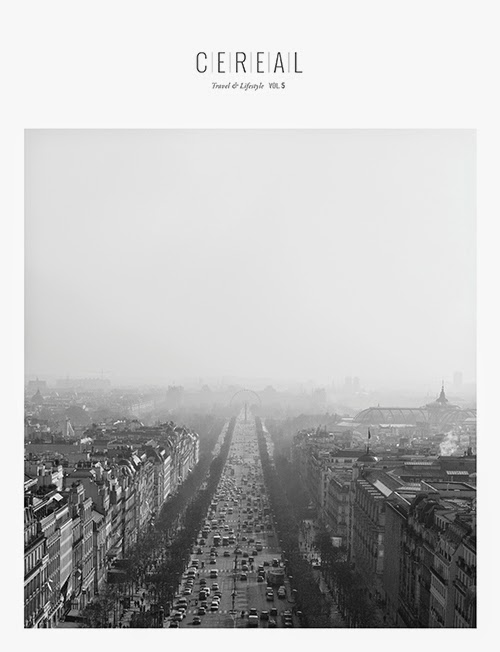
I found Cereal Magazine by chance, gazing absent-mindedly through the never ending shelves of publications at Magma; as soon as I eyed its greyscale cover, with Paris photographed in black and white and the simplicity of its font, I knew it was love at first sight. 

The inside didn't disappoint. With the majority of lifestyle/fashion magazines nowadays we are used to being bombarded by colour, graphics, striking and attention- grabbing text; everything over the top, magnified. Cereal has a soothing effect in my eyes. I can feel my mind quieting down from all the noise we are fed everyday through the media and entering a zen state of mind, flipping through its thick, textured pages with incredibly beautiful photographs of the Cornish seaside to black and white Paris. The text also provides an escape from my mundane day-to-day, transporting me to Helsinki's architectural scene or a secret rainforest in the Scilly islands. 

I do not know how I will survive until the next issue comes out. My hunger for what I call "beautiful journalism" will have to be quenched by their blog, overflowing with equally-stunning images. 
Enjoy


XOXO

P.D. You can read here the editor's letter from Issue 5. It is a love-letter to travelling (and travellers)

Monday, 31 March 2014

Books #3. Jeune Fille en Dior ....


In Jeune Fille en Dior, released in French bookstores in October, the illustrator Annie Goetzinger invites us to follow her heroine behind the scenes at 30 Avenue Montaigne, during the era of Monsieur Dior. 
A visual novel in which fiction mixes with the house's history with poetic freshness.


On February 1947, just before Christian Dior's debut fashion show, the level of excitement and anticipation was at fever pitch. It's here that the story of the house of Dior starts, and with it the story of Clara, a young reporter from a modest background for the magazine Jardin des Modes, the creation of the illustrator Annie Goetzinger. Through her awestruck eyes we rediscover the tony atmosphere of the house's historic heart and the rich clients coming to see the collection, the behind-the-scenes buzz, the attentiveness of Monsieur Dior to his "cheries" - the women who inspired him  - and his "jeunes filles" - the house models. And not forgetting the enthusiastic reaction of the journalists who, like Carmel Snow of Harper's Bazaar, sang the praises of the "New Look". As the fates of the couturier and Clara converge, with her also becoming a "jeune fille", the book retraces Dior's global success, the rituals preceding the showing of each collection, transporting us from Paris to Dallas, passing by Granville, until Christian Dior's death in 1957. 


For Annie Goetzinger, the author and illustrator of Jeune Fille en Dior, after having worked with the biggest names in comic book publishing, the idea of an illustrated novel about the house at 30 Avenue Montaigne arose quite naturally. "I wanted to recount how Dior built his house. There was a real before and after that famous fashion show of 1947." explained this woman who had grown up in a family of dressmakers before starting her career as a fashion illustrator. With equal priority given to the details of her drawings as to the facts they relate, Annie Goetzinger brings to life the creative yeats that shaped the house's foundation: a colourful story, as captivating to read as it is beautiful to look at.

Buy the book at Dargaud

Source: Dior Magazine

XOXO

Thursday, 20 March 2014

Spring is not near, it's here ...


Al siempre va. Mantengo mi postura.
Si sale nunca, la esperanza es muerte.
Si sale amor, la primavera avanza.

                                                                                                                Ángel González


XOXO

Saturday, 15 March 2014

Looking Back. La Llamada / The Call ....


I remember reading this piece of writing at High School. It was during a mock exam for Spanish Language. Everybody was expecting an endless, boring article about the misuse of Vs and Bs but instead we found this surprisingly touching short story and a minute after, all the girls sighted and looked up with dreamy eyes, as if they had just felt the emotions written on the paper. 
 Is one of those fleeting moments that somehow stay in your memory long after you leave those halls. It was written and published in 2001 which means we already read it years afterwards and now, 11 years later, it feels as current as if it was written yesterday.
After last night's charade down memory lane with Britney, Black Street Boys and 50 cent, I though it was worth remembering, for old times' sake.


Llamada

MANUEL VICENT 8 DIC 2002

No había nadie en el bar salvo ellos dos, una pareja de adolescentes sentados frente a frente, bebiendo inocentes refrescos de naranja. En la mesa entre los vasos habían dejado abiertos los teléfonos móviles, que sonaban a veces y entonces él o ella se ponía a charlar alegremente con un ser ajeno e invisible mientras el otro se quedaba hierático. El chico estaba muy enamorado de la chica, pero era incapaz de manifestarle su pasión. Sólo se atrevía a mirarla con intensidad a los ojos y ella ya había captado las turbulencias del corazón de su amigo y también le amaba, pero no podía ayudarle en nada, debido a su extremada timidez. Hablaban de cosas anodinas, sin comprometerse en absoluto. Las palabras iban del uno al otro directamente a través de la vibración del aire sobre el mármol de la mesa. El chico necesitaba declararle su amor y la chica esperaba que lo hiciera ya de una vez, un sueño imposible, porque entre ellos había una barrera psicológica insalvable. Cualquier gesto o inflexión de voz, al estar sus rostros tan cerca, podía delatar un sentimiento íntimo y eso les llenaba de terror. Había media luz en el bar, el hilo musical vertía una melodía propicia y los labios de los enamorados permanecían a una mínima distancia infranqueable. El corazón de los adolescentes tiene hoy un compartimento más. Se compone de dos ventrículos, de dos aurículas y de un teléfono móvil, que también bombea sangre. De pronto, este joven tímido y enamorado tuvo una inspiración. Usó el móvil para hablar con la chica que tenía delante sin dejar de mirarla profundamente a los ojos. Cuando sonó la llamada la chica descolgó. La pareja comenzó a hablarse de forma descarnada como si fueran invisibles. Ninguno de los dos ignoraba que a través de los móviles su voz se convertía en ondas electromagnéticas, viajaba al espacio sideral y luego volvía para penetrar en el cerebro del otro. Brutalmente desinhibido el chico le dijo la amaba. La chica le contestó que todas las noches soñaba con él, pero sus expresiones de amor sin amarras tenían dos vehículos: una voz recorría el aire sobre la mesa del bar por medio de la vibración natural y sonaba terriblemente vulgar; la otra bajaba desde un satélite de la estratosfera cargada de libertad e imaginación. "Te amo, te amo"-le decía el chico. "Oigo dos voces a la vez, ¿a cuál de ellas debo creer?"- preguntó ella. El chico le dijo que creyera en el amor que a través de las ondas magnéticas le llegaba por la sangre hasta el corazón. 


There was nobody in the bar except two of them, a teenage couple sitting face to face, drinking innocent orange sodas. On the table between the glasses, they had left open their mobile phones, which buzzed at times and then he or she started chatting happily with someone else remote and invisible while the other remained inscrutable . The boy was very much in love with the girl, but was unable to express his passion. He only dared to look intently into her eyes and she had already captured the turmoil in his friend's heart and loved him back, but could not help him at all because of her extreme shyness . They talked about ordinary things, without compromising at all. The words went from one to another directly through the vibration of air on the marble table. The boy needed to declare his love and the girl expected it once and for all, an impossible dream because between them there was an insurmountable psychological barrier. Any gesture or inflection, being their faces so close, could reveal an intimate feeling, and that filled them with terror. The bar was half lit, the music propitious and the lover’s lips remained at a minimum impassable distance. The hearts of teens today have one more compartment. It consists of two ventricles and two atria of a mobile phone, which also pumps blood. Suddenly this young, shy and enamoured boy had an inspiration. He used the phone to talk to the girl in front of him without taking his eyes off her. When it rang the girl picked up the call. The couple began to speak with complete lack of inhibition, as if they were invisible. Both were aware that through the mobiles, their voices became electromagnetic waves traveling into space and then back to penetrate the brain of the other. Brutally uninhibited the boy said he loved her. The girl replied that every night she dreamed of him, but his expression of loosened love had two vehicles:  one voice travelled through the air over the table in the bar by  natural vibration and sounded terribly vulgar , the other came down from a stratospheric satellite charged with freedom and imagination . “I love you, I love you," the boy said. "I hear two voices at once, which of them should I believe?” - She asked. The boy told her to believe in the love which through the magnetic waves reached her through the blood and then to her heart .


XOXO

Wednesday, 12 February 2014

First Pictures. Suite Française....


Finding out the beautifully written "Suite Française" was becoming a movie, with Michelle Williams (My Week With Marilyn) and Matthias Schoenaerts (Rust and Bone) was both exciting and terrifying. The book is written with such care and detail that I would hate to see it spoiled into a badly done film. However, cinematically speaking it could be amazing. The rich language of the novel allows for plenty of visual material to work with and it is the 1940s, it cannot look bad. 

Costume designer responsible is Michael O'Connor (he won an Oscar for The Dutchess). There is no specific information on the costumes yet but I am expecting plenty of uniforms, both French and German, flower patterns and natural fabrics like cotton, linnen and wool. 


As France Burned
Review by PAUL GRAY
Published: April 9, 2006. The New York Times

THIS stunning book contains two narratives, one fictional and the other a fragmentary, factual account of how the fiction came into being. "Suite Française" itself consists of two novellas portraying life in France from June 4, 1940, as German forces prepare to invade Paris, through July 1, 1941, when some of Hitler's occupying troops leave France to join the assault on the Soviet Union. At the end of the volume, a series of appendices and a biographical sketch provide, among other things, information about the author of the novellas. Born in Ukraine, Irène Némirovsky had lived in France since 1919 and had established herself in her adopted country's literary community, publishing nine novels and a biography of Chekhov. She composed "Suite Française" in the village of Issy-l'Evêque, where she, her husband and two young daughters had settled after fleeing Paris. On July 13, 1942, French policemen, enforcing the German race laws, arrested Némirovsky as "a stateless person of Jewish descent." She was transported to Auschwitz, where she died in the infirmary on Aug. 17.


The date of Némirovsky's death induces disbelief. It means, it can only mean, that she wrote the exquisitely shaped and balanced fiction of "Suite Française" almost contemporaneously with the events that inspired them, and everyone knows such a thing cannot be done. We can now see that Némirovsky achieved just such coherence and irony with an ex post facto view of, at most, a few months. Nobody knew about the existance of "Suite Française" at the time , including Némirovsky's elder daughter, Denise, who saved the leatherbound notebook her mother had left behind but refused to read it, fearing it would simply renew old pains. (Her father, Michel Epstein, was sent to Auschwitz several months after her mother and was consigned immediately to the gas chamber.) Not until the late 1990's did Denise examine what her mother had written and discover, instead of a diary or journal, two complete novellas written in a microscopic hand, evidently to save scarce paper. Denise abandoned her plan to give the notebook to a French institute preserving personal documents from the war years and instead sent it to a publisher. "Suite Française" appeared in France in 2004 and became a best seller.

We now know what happened. Némirovsky lost her life in what she foresaw as a life in "captivity". The improbable survival of her two novellas is a cause for celebration and also for grief at another reminder of the horrors of the Holocaust. She wrote what may be the first work of fiction about what we now call World War II. She also wrote, for all to read at last, some of the greatest, most humane and incisive fiction that conflict has produced.

XOXO

P.D. Read the full article here

Saturday, 28 December 2013

Books #3


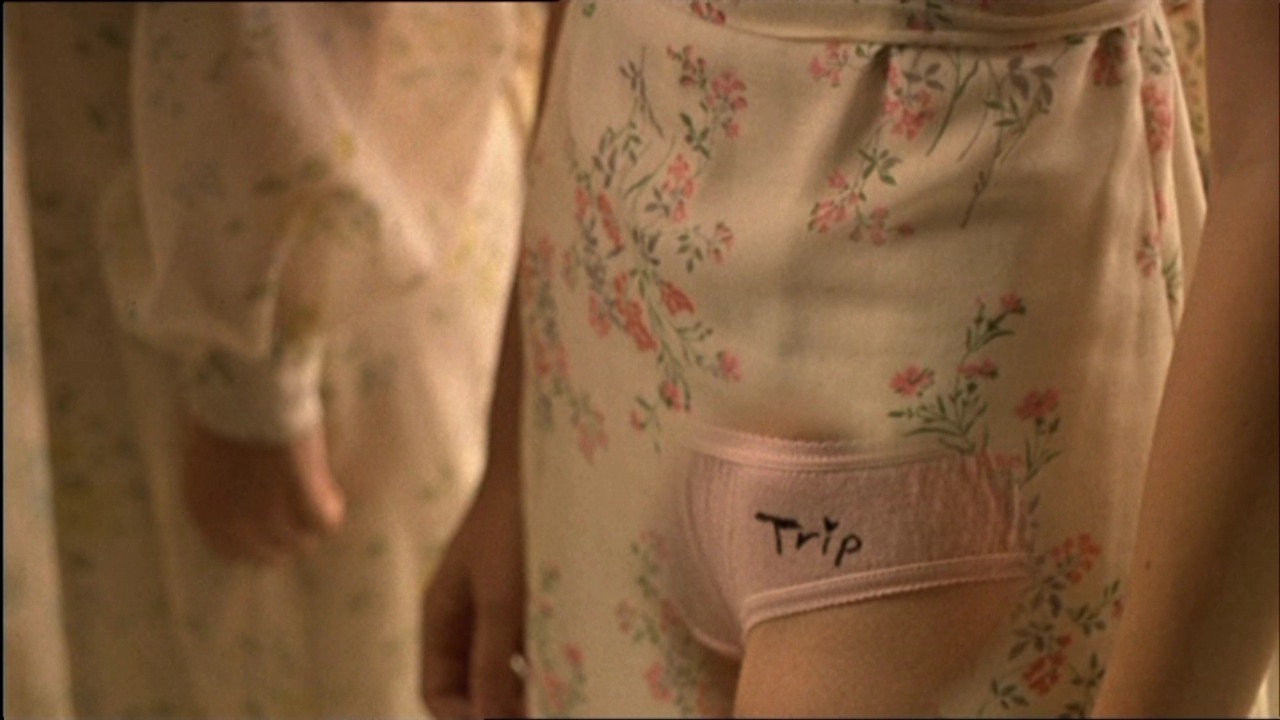
It was about time I gave a little attention to this absolute classic. Published over two decades ago, The Virgin Suicides by Jeffrey Eugenides, is indisputably one of the most influential reads of contemporary literature, both in content and style. Writing a book about the mass suicides of 5 sisters in a small town in Michigan is no easy task, but it is even harder to do so using as a narrator a group of infatuated, close- to - obsessive  teenage boys, now grown up, reminiscing about the cloistered lives of the Lisbon girls. The style, however, is what struck me most about the novel. The attention to detail, as if each adjective has been carefully chosen, softly placed into the sentence to kindle your imagination and transport you to a candle-lit room or the boys' tree house. What it never does is let you in any of the girl's heads. Their surroundings: school corridors, interior of their rooms, house, front yard, clothing ect are described down to the last scratch. But we are never allowed into the brains or the emotions which led down to their ends. The mystique which the Lisbon sisters have over the boys is the same one that possesses the reader and it is both absorbing and infuriating at times; you want to scream at the girls' window, tell them to get out, run and never look back. 

Hauntingly beautiful and heartbreaking, it is a must read. 


The New York Times
By MICHIKO KAKUTANI
March 19, 1993

"It didn't matter," Mr. Eugenides's narrator recalls, "whether her brain continued to flash on the way down, or if she regretted what she'd done, or if she had time to focus on the fence spikes shooting toward her. Her mind no longer existed in any way that mattered. The wind sound huffed, once, and then the moist thud jolted us, the sound of a watermelon breaking open, and for that moment everyone remained still and composed, as though listening to an orchestra, heads tilted to allow the ears to work and no belief coming in yet. Then Mrs. Lisbon, as though alone, said, 'Oh, my God.' " On her second try, her daughter Cecilia had succeeded in "hurling herself out of the world."

This terrible event, along with the subsequent suicides of Cecilia Lisbon's four pretty sisters, feels like something out of a Greek tragedy. It's not at all the sort of thing one expects to find in a coming-of-age story set in the leafy Detroit suburbs of the 70's; and as related by Mr. Eugenides, the deaths of the five Lisbon sisters take on the high, cold shimmer of myth. Their suicides become a symbol of the innocence lost as adolescents are initiated into the sad complexities of grown-up life, and the lost, dying dreams of a community that finds its collective dreams of safety spinning out of reach.

Beautiful and eccentric, the sisters have captured the imagination of the neighborhood boys, who spend hours spying on them and collecting souvenirs of their lives: snapshots taken by neighbors, cosmetics stolen from the garbage, a brassiere filched one night from the house. What is the girls' magical allure? In an ordinary suburban world of lawnmowers and barbecues, they represent the extraordinary: the odd, the inexplicable, the romantically extreme.

Under the thumb of their domineering mother -- who never allows them to date, and who insists they wear baggy, ridiculous clothes -- the Lisbon girls lead strangely hermetic lives, defined by church and school. Though their ineffectual father seems vaguely sympathetic to their plight, he never stands up to their tyrannical mother.

Eventually the boys succeed in taking the Lisbon sisters on a single group date, but Lux breaks her mother's curfew and the girls are permanently grounded. They are pulled out of school and locked in the house. In one memorable scene, their suitors make a last-ditch effort at communication. Having managed to get the girls on the phone, they begin playing them their favorite songs: "You've Got a Friend," "Wild Horses" and "Time in a Bottle." The girls respond by furtively playing some of their favorite songs: "Alone Again, Naturally," "Where Do the Children Play?" and "So Far Away."

Nothing, however, impedes the girls' withdrawal from the world. "The house receded behind its mists of youth being choked off," Mr. Eugenides's narrator recalls, "and even our own parents began to mention how dim and unhealthy the place looked." Leaves pile up on the lawn, garbage collects by the curb, and at night, raccoons prowl its yard. Sour, unpleasant smells seep out of the house, and grime and dust soon cover over its windows and doors.

The reader repeatedly wonders why the girls don't rebel. Why don't they reach out to friends, or run away from home? Why don't the authorities insist that they go to school? What has driven their mother to impose such a strict regime in the first place?

 Gradually, however, the narrator's hypnotic voice succeeds in transporting us to that mythic realm where fate, not common sense or psychology, holds sway. By turns lyrical and portentous, ferocious and elegiac, "The Virgin Suicides" insinuates itself into our minds as a small but powerful opera in the unexpected form of a novel.


XOXO